AI agent assist is quickly becoming one of the most powerful ways to boost productivity, delight customers, and empower teams to do their best work. According to the iLounge article on AI Call Center Solutions, this technology enhances personalization by leveraging real-time insights and analytics. Instead of replacing people, it acts as a smart co‑pilot that supports them in real time, handling repetitive tasks, surfacing the right information, and recommending next best actions—showcasing how AI in call centers enhances personalization through data analytics.
Beyond customer service, AI agent assist is helping businesses take advantage of cloud computing solutions for managing large data to make processes faster and more efficient. Companies now rely on big data tools in cloud platforms to track customer trends, improve workflow efficiency, and make smarter decisions. With the support of modern computer systems and technology infrastructure, organizations can automate routine work, simplify team collaboration, and reduce errors.
In marketing, AI tools for digital marketing campaigns allow teams to understand customer behavior, create targeted messages, and measure results in real time. Using artificial intelligence in automated marketing, businesses can personalize content, predict audience preferences, and improve campaign performance. Likewise, in finance, AI solutions for smarter financial planning and risk management help companies spot unusual patterns, forecast trends, and provide clients with personalized advice faster and more accurately.
By combining AI agent assist with these technologies, teams can work more efficiently, access the information they need instantly, and focus on high-value tasks. Linking cloud computing services with AI-driven business insights, digital marketing automation using AI analytics, and financial technology powered by AI intelligence creates a smooth workflow that supports every part of the business. This integration ensures employees can deliver better customer experiences, make smarter decisions, and keep operations flexible and future-ready.
Top 10 Contact Center Solutions for AI Agent Assist
The modern contact center is evolving quickly, and organizations are increasingly looking for AI-powered tools to improve customer support, agent efficiency, and personalization. AI agent assist plays a key role in helping teams respond faster, provide accurate information, and deliver consistent experiences across all channels. Here are the top 10 contact center solutions designed to optimize performance and enhance customer engagement.
1. Bright Pattern – AI-Powered Contact Center Platform
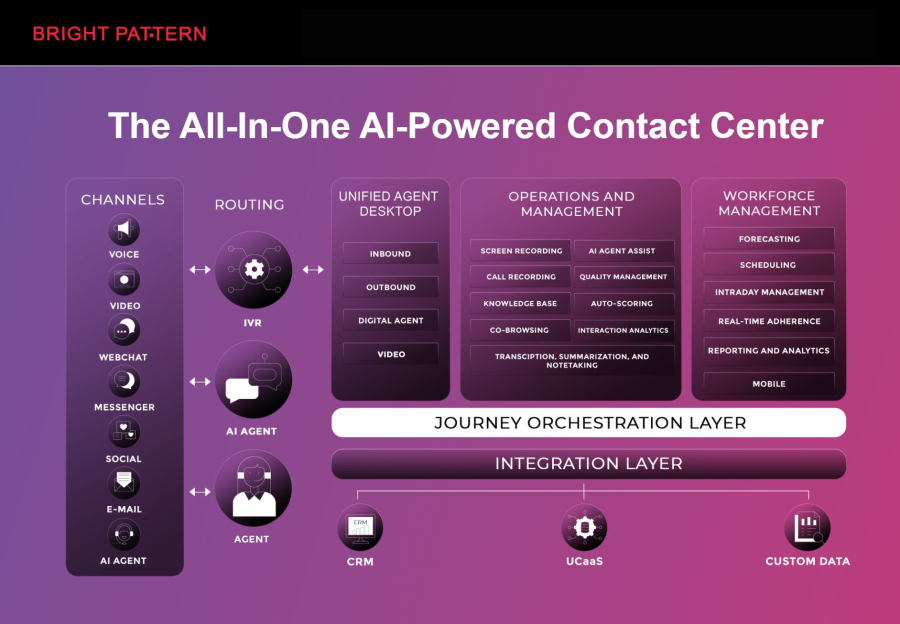
Bright Pattern is a leading contact center solution that integrates AI agent assist to improve agent productivity and customer satisfaction. Its cloud-based platform supports omnichannel communication, allowing agents to interact seamlessly across voice, chat, email, social media, and messaging apps.
Key features include:
- AI agent assist that provides real-time recommendations and next-best-action guidance
- Intelligent routing to connect customers with the right agent quickly
- Advanced analytics for monitoring agent performance and customer trends
- Seamless CRM and third-party system integration
- Scalable cloud infrastructure that supports remote teams
Bright Pattern’s combination of AI, cloud technology, and omnichannel capabilities makes it ideal for organizations seeking a modern, intelligent contact center solut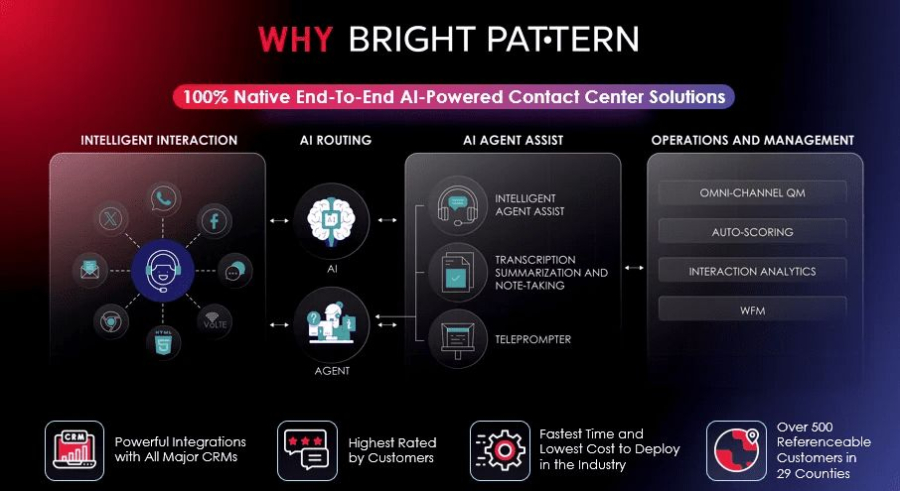 ion.
ion.
2. Genesys Cloud
Genesys Cloud offers a flexible platform with AI-powered routing, workforce management, and reporting tools. It enables contact centers to implement AI agent assist for real-time guidance and workflow automation.
3. Five9
Five9 provides cloud contact center solutions that incorporate AI-driven insights, automated agent support, and predictive dialing to enhance both customer and agent experiences.
4. Talkdesk
Talkdesk leverages AI agent assist to support agents with knowledge retrieval, automated workflows, and sentiment analysis for more personalized interactions.
5. NICE inContact
NICE inContact CXone offers AI-powered routing, performance analytics, and virtual agent support, helping businesses improve efficiency and customer satisfaction.
6. Avaya OneCloud
Avaya OneCloud integrates AI agent assist to streamline workflows, provide intelligent insights, and support omnichannel customer engagement.
7. RingCentral Contact Center
RingCentral provides cloud-based solutions with AI agent assist capabilities that guide agents, automate tasks, and improve response times.
8. 8x8 Contact Center
8x8 offers AI-enhanced contact center tools for automated assistance, sentiment analysis, and real-time agent guidance to optimize customer interactions.
9. Cisco Contact Center
Cisco Contact Center solutions use AI agent assist to deliver real-time recommendations, analytics, and omnichannel engagement tools for improved agent performance.
10. Vonage Contact Center
Vonage combines cloud contact center technology with AI agent assist to support workflow automation, predictive analytics, and personalized customer interactions.
What Is AI Agent Assist?
AI agent assistrefers to software powered by artificial intelligence that works alongside human agents to help them complete their work more efficiently and accurately. Instead of interacting directly with end users only, it focuses on supporting the human agent while they work.
Think of it as a real‑time, always‑on assistant that can:
- Listen to or read live customer interactions.
- Suggest responses, next steps, or solutions.
- Search knowledge bases and policies instantly.
- Automate follow‑up documentation and summaries.
- Guide new or less experienced staff through complex processes.
The result is a powerful human plus AI partnership, where people handle empathy, judgment, and relationship‑building, and the AI tackles speed, consistency, and information retrieval.
Why AI Agent Assist Is So Valuable
Organizations adopt AI agent assist because it delivers clear, measurable benefits while keeping people in control. Below are some of the most impactful outcomes.
1. Faster Responses and Resolutions
Agents often spend a large portion of their time searching for the right answer, checking policies, or asking colleagues for help. AI agent assist can cut this time dramatically by:
- Surfacing relevant knowledge articles as soon as a question is detected.
- Providing suggested replies that agents can send as‑is or quickly refine.
- Highlighting key information from long documents or past interactions.
This helps reduce average handle time, shrink backlogs, and improve responsiveness without sacrificing quality.
2. Higher Quality and Consistency
Even the best teams can struggle with delivering a consistent experience, especially when policies change frequently or the product range is complex. AI agent assist helps enforce consistency by:
- Drawing answers directly from approved, up‑to‑date sources.
- Recommending compliant language for regulated industries.
- Reducing guesswork and minimizing human error.
Customers benefit from reliable, accurate information, and leaders gain confidence that interactions align with guidelines.
3. Happier, More Confident Agents
Work is more enjoyable when people feel supported and successful. AI agent assist boosts agent satisfaction by:
- Removing repetitive tasks, such as manual note‑taking and summarization.
- Acting as a safety net for complex or unfamiliar questions.
- Shortening the time it takes new hires to become confident and effective.
As agents spend more time on meaningful, high‑value conversations and less on busywork, job satisfaction and retention tend to improve.
4. Faster Onboarding and Training
Training new team members can be costly and time‑consuming. AI agent assist speeds up onboarding by:
- Providing real‑time guidance during live interactions.
- Offering step‑by‑step prompts for complex workflows.
- Reducing the need to memorize large volumes of information.
New hires can contribute faster, with fewer mistakes, because the AI guides them exactly when and where they need support.
5. Better Insights for Continuous Improvement
AI agent assist systems can analyze conversations at scale and highlight patterns that are hard to spot manually, such as:
- Common customer pain points and repeated questions.
- Opportunities to improve self‑service content.
- Training topics where agents most often need help.
These insights can inform product decisions, policy updates, and coaching programs, driving ongoing improvements across the organization.
Core Capabilities of Modern AI Agent Assist
Today’s AI agent assist solutions combine several powerful capabilities to support teams end to end.
|
Capability |
What It Does |
Key Benefit |
|
Real‑time suggestion |
Generates responses, next steps, and recommendations during live interactions. |
Speeds up conversations and increases first contact resolution. |
|
Knowledge retrieval |
Searches FAQs, documents, and policies based on conversation context. |
Reduces time spent hunting for information. |
|
Summarization |
Creates concise summaries of calls, chats, and emails. |
Saves agents time and improves handovers. |
|
Workflow guidance |
Walks agents through multi‑step processes and forms. |
Reduces errors and training overhead. |
|
Sentiment and intent detection |
Identifies customer tone and goals in real time. |
Helps agents adapt their approach and prioritize. |
|
Post‑interaction automation |
Automates follow‑ups like emails, tickets, and internal notes. |
Frees agents from repetitive after‑call work. |
Real‑World Use Cases for AI Agent Assist
AI agent assist is flexible enough to create value across many functions. Here are some of the most common and impactful use cases.
Customer Support and Service Desks
In contact centers and support teams, AI agent assist can:
- Recommend answers drawn from knowledge bases during calls and chats.
- Suggest troubleshooting steps based on device, issue type, and history.
- Auto‑generate tickets, tags, and case notes after each interaction.
- Flag urgent or at‑risk conversations based on sentiment and keywords.
This leads to faster resolutions, higher customer satisfaction, and a more scalable support operation.
Sales and Customer Success Teams
AI agent assist can also support revenue teams by:
- Surfacing objection‑handling scripts at the right moment.
- Summarizing discovery calls with key needs and next steps.
- Highlighting upsell or cross‑sell opportunities based on conversation cues.
- Helping new sales reps learn product positioning in context.
By keeping reps focused on the customer rather than their notes, AI agent assist helps build stronger relationships and drive more consistent results.
Operations and Back‑Office Teams
Behind the scenes, many operational processes are rule‑based but complex. AI agent assist helps by:
- Guiding staff through eligibility checks, approvals, and compliance steps.
- Standardizing how exceptions and edge cases are handled.
- Reducing time spent updating records and documentation.
This keeps operations smooth and reduces the risk of costly errors or delays.
Knowledge Workers and Specialists
Beyond frontline teams, AI agent assist can boost the productivity of analysts, consultants, and other knowledge workers by:
- Quickly summarizing long reports and research materials.
- Drafting initial versions of emails, proposals, or documentation.
- Helping compare scenarios and highlight key trade‑offs.
Specialists still make the final decisions, but the AI accelerates the work required to get there.
How AI Agent Assist Typically Works
While implementations vary, most AI agent assist solutions follow a similar pattern from input to action.
- Capturethe interaction. The system reads text (such as chat or email) or transcribes spoken conversations in real time.
- Understandthe context. Natural language processing identifies intent, entities, and sentiment.
- Retrieve and reasonover knowledge. The AI searches relevant sources, compares options, and applies business logic or policies.
- Suggest actions or contentto the agent. This might be a drafted response, a set of steps, or a recommended action.
- Learn and improveover time. Feedback from agents and outcomes from interactions help the system refine future suggestions.
Agents remain in control at every step. They choose whether to accept, edit, or ignore the AI’s suggestions, ensuring that human judgment and empathy always lead.
Designing a High‑Impact AI Agent Assist Program
To unlock the full value of AI agent assist, it helps to think of it as an ongoing program rather than a one‑time tool deployment.
1. Start With Clear Objectives
Define what success looks like before you begin. Common goals include:
- Reducing average handle time or resolution time.
- Improving customer satisfaction or quality scores.
- Speeding up onboarding for new agents.
- Decreasing after‑call or after‑ticket work.
Clear objectives guide which features to prioritize and how to measure impact.
2. Invest in Clean, Centralized Knowledge
AI agent assist is only as good as the information it can access. Strengthen your content foundation by:
- Consolidating key policies, FAQs, and process documents.
- Removing outdated or conflicting articles.
- Tagging and structuring content so it is easy for AI to search.
Well‑organized knowledge leads directly to more accurate and helpful suggestions.
3. Engage Agents Early and Often
Agent buy‑in is essential. Involve frontline teams by:
- Gathering input on pain points and workflow bottlenecks.
- Piloting with a small group of agents who can champion the solution.
- Encouraging honest feedback and incorporating it into improvements.
When agents see AI as a genuine partner that makes their jobs easier, adoption climbs and results improve.
4. Train for Collaboration, Not Replacement
Position AI agent assist as a collaborator, not a competitor. Training should highlight:
- How to review, adjust, and personalize AI‑generated responses.
- When to trust AI suggestions and when to double‑check.
- How to provide feedback to continually improve the system.
This approach builds confidence and keeps humans firmly in control of the customer experience.
Measuring the Success of AI Agent Assist
To prove value and optimize over time, track metrics before and after rolling out AI agent assist. Useful indicators include:
- Efficiency metricssuch as average handle time, first contact resolution, and after‑call work time.
- Experience metricslike customer satisfaction scores, net promoter score, and quality assurance outcomes.
- Employee metricsincluding agent satisfaction, onboarding time, and turnover rates.
- Adoption metricssuch as the percentage of interactions where AI suggestions are used or accepted.
Regularly reviewing these metrics helps you identify where AI agent assist is working best and where there is room to refine content, prompts, or workflows.
Addressing Common Concerns Positively
AI agent assist is most successful when organizations proactively address questions and concerns.
- Job impact.The goal is to elevate human work, not eliminate it. Emphasize how AI takes over low‑value tasks so agents can focus on complex, relationship‑driven work.
- Accuracy.Combine AI with strong governance: approved knowledge sources, regular reviews, and clear escalation paths for edge cases.
- Compliance and privacy.Work with legal and compliance teams to define how data is used, stored, and protected, and ensure that AI suggestions adhere to relevant regulations.
Handled thoughtfully, AI agent assist becomes a trusted part of how teams operate every day.
Practical First Steps to Implement AI Agent Assist
If you are ready to explore AI agent assist, you do not need to transform everything at once. A focused, step‑by‑step rollout can deliver strong early wins.
- Choose one high‑impact use case.For example, start with chat support for a specific product line or focus on summarizing calls for one team.
- Define success metrics.Decide how you will measure improvement, such as reduced handle time or increased customer satisfaction.
- Prepare your knowledge base.Update and organize key content that the AI will rely on.
- Run a pilot.Launch with a small group of agents, gather feedback, and iterate quickly.
- Scale gradually.Expand to more teams, channels, or workflows once the initial use case is delivering clear value.
The Future of Work With AI Agent Assist
AI agent assist is more than a trend. It is a practical, powerful way to help people do their best work, every day. By pairing human empathy and expertise with AI’s speed and consistency, organizations can:
- Deliver faster, more reliable service to customers.
- Empower agents to focus on meaningful, high‑value tasks.
- Turn every interaction into a source of insight and improvement.
Teams that embrace AI agent assist now are building a stronger, more resilient foundation for the future of work. With thoughtful design, clear objectives, and a people‑first mindset, AI becomes a powerful ally that helps everyone win.
